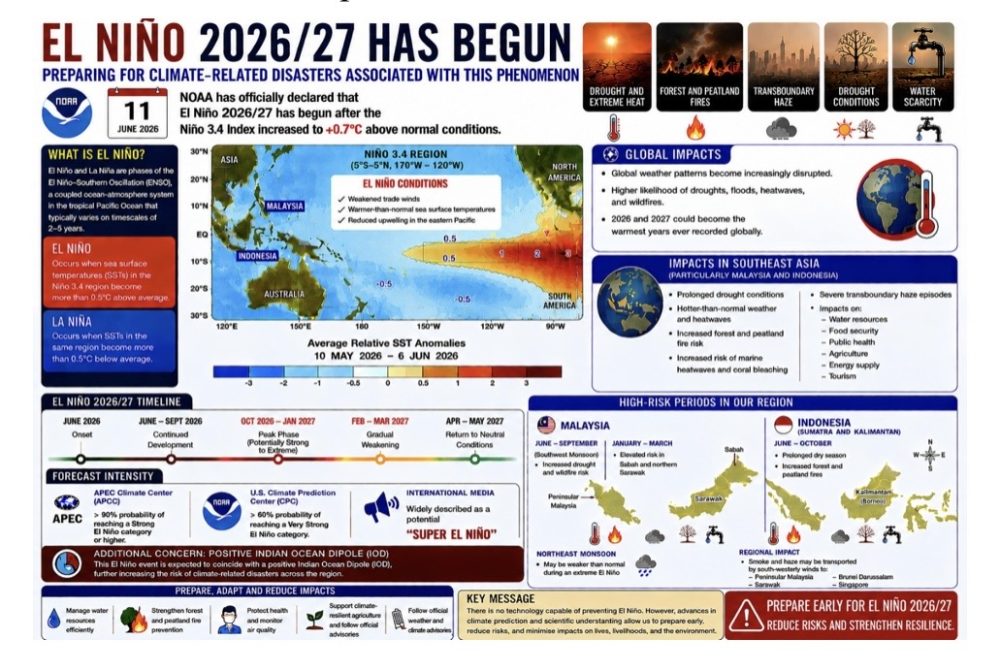
THE United States National Oceanic and Atmospheric Administration (NOAA) officially declared on 11 June 2026 that El Niño 2026/27 had commenced after the Niño 3.4 Index, the principal indicator used to monitor El Niño and La Niña conditions, rose to +0.7°C above the long-term climatological average.
The Niño 3.4 Index is calculated from average sea surface temperatures in the central-eastern tropical Pacific Ocean (5°S–5°N) and compared with long-term normal conditions.
Under the widely accepted definition, El Niño conditions occur when sea surface temperature anomalies in this region exceed +0.5°C, while La Niña conditions occur when temperatures fall at least 0.5°C below average.
El Niño and La Niña are manifestations of the El Niño–Southern Oscillation (ENSO), a coupled ocean–atmosphere system operating across the tropical Pacific basin. ENSO typically oscillates on time scales of 2 to 5 years and is one of the most influential natural climate phenomena, affecting weather and climate patterns worldwide.
This article is the third in my series discussing El Niño 2026/27. My research has been closely associated with this phenomenon, not only in understanding ENSO dynamics itself but also in examining how ocean–atmosphere interactions influence the global climate system.
My work on El Niño began during my doctoral studies at the University of British Columbia, Canada, between 1993 and 1997, where I focused on El Niño prediction.
Subsequently, over more than two decades at Universiti Kebangsaan Malaysia (UKM), my research team and I conducted numerous studies to understand ENSO teleconnections and how these phenomena influence weather and climate across Southeast Asia, including Malaysia and Indonesia.
Over recent months, various forecasts and assessments have been issued regarding the likelihood of El Niño 2026/27 developing. As anticipated, the event has now been officially declared.
Current forecasts indicate that El Niño will continue to strengthen throughout 2026, reaching its peak towards the end of the year or in early 2027, before gradually weakening.
Conditions in the Pacific Ocean are expected to return to a neutral state around April or May 2027.
Of particular concern is the projected intensity of this event. Several international climate forecasting centres suggest that El Niño 2026/27 could reach a very strong or even extreme category, comparable to, or potentially exceeding, the major El Niño events of 1997/98 and 2015/16, both of which had substantial global impacts.
The APEC Climate Center (APCC) in Busan, South Korea, projects a probability exceeding 90 percent that the event will attain at least a strong El Niño classification.
Meanwhile, the United States Climate Prediction Center estimates a probability exceeding 60 percent that El Niño 2026/27 will reach a very strong category. Several international media outlets have already begun referring to the event as a “Super El Niño”.
Even more concerning is the expectation that this El Niño may coincide with a positive Indian Ocean Dipole (IOD). The combination of these two climate phenomena typically amplifies the risk of extreme weather and climate-related disasters in many parts of the world, particularly across Southeast Asia.
Why is El Niño 2026/27 expected to be so significant?
When El Niño develops, global weather and climate patterns become disrupted. Some regions experience severe drought, while others face excessive rainfall and major flooding. Many areas also experience higher-than-normal temperatures, more frequent heat waves, and increased wild fire activity.
From a global temperature perspective, there is a very high likelihood that either 2026 or 2027 could become the warmest year ever recorded. Previously, 2023 and 2024 ranked among the warmest years in modern history, partly due to the influence of the 2023/24 El Niño event, which was categorised as strong. However, El Niño 2026/27 is expected to be even more intense.
For Southeast Asia, particularly Malaysia and Indonesia, El Niño is commonly associated with prolonged drought, hotter-than-normal conditions, an increased likelihood of heatwaves, forest and peatland fires, and severe transboundary haze episodes.
El Niño: warmer sea surface temperatures and lower sea levels in Southeast Asian seas that can cause coral bleaching. These impacts affect numerous sectors, including the environment, water resources, food security, agriculture, public health, energy supply, tourism, and the wider economy.
The risks increase further if El Niño coincides with a positive IOD. Experience from the strong El Niño episodes of 1997/98 and 2015/16 demonstrated that the combined influence of these phenomena can produce more severe drought conditions and widespread forest fires in Indonesia, particularly across Sumatra and Kalimantan.
Based on current scientific understanding, the risk of drought, hot weather, and forest fires in Malaysia typically increases between June and September during the Southwest Monsoon.
These conditions may persist into the following year, particularly between January and March, especially in Sabah and northern Sarawak. At the same time, the Northeast Monsoon, which normally brings substantial rainfall to Malaysia, may become weaker during an extreme El Niño event.
In Indonesia, particularly in Sumatra and Kalimantan, drier-than-normal conditions are expected between June and October. This period represents the most critical season for forest and peatland fires.
Should large-scale fires occur, smoke and haze may be transported by south-westerly winds towards Peninsular Malaysia, Sarawak, Brunei Darussalam, and Singapore, significantly affecting air quality and public health.
In Malaysia, extensive peatlands in Sarawak, Sabah, and several states in Peninsular Malaysia also face an elevated risk of fire during prolonged dry spells.
The reality is that no technology exists to prevent El Niño, as it is a natural component of the Earth’s climate system. Furthermore, an increasing body of scientific evidence suggests that global warming may increase both the frequency and intensity of extreme El Niño events in the future.
Nevertheless, advances in climate science now allow these events to be predicted several months in advance. Early forecasts provide governments, relevant agencies, the private sector, and the public with valuable opportunities to prepare.
Measures such as improved water resource management, enhanced wildfire preparedness, public health monitoring, agricultural planning, and disaster risk reduction strategies can be implemented in advance to minimise potential impacts.
El Niño 2026/27 should therefore not be viewed merely as another climate phenomenon. Rather, it should be regarded as an early warning signal for all sectors of society to strengthen preparedness and resilience against climate-related disasters.
Through careful planning, the effective use of scientific information, and proactive action, the impacts of this event can be substantially reduced, even if they cannot be completely avoided.
Emeritus Professor Dr Fredolin Tangang is a climatologist and climate change expert, Emeritus Professor at Universiti Kebangsaan Malaysia, Fellow of the Academy of Sciences Malaysia, and currently affiliated with Universiti Brunei Darussalam. He is a former Vice-Chair of Working Group I of the Intergovernmental Panel on Climate Change (IPCC), United Nations.